


First published in 1967, The Outsiders has become a cornerstone of American young adult fiction and a book that redefined what stories about teenagers could sound and feel like. Reading it now, nearly sixty years later, what stands out isn’t just its historical significance, but how alive it still feels.
I grew up in Oklahoma, born and raised in Tulsa, and somehow I went my whole life without reading The Outsiders. That’s practically a felony here, I’m now realizing, when I bring this up in a room. Everyone knows the book, the movie, the museum. You can’t drive through town without spotting a film reference somewhere. People can quote it mindlessly without even realizing where it’s from. It’s one of those things you’re supposed to just know if you grew up here. And still, I managed to miss it.
It wasn’t until this year, after seeing The Outsiders: The Musical, that I finally picked up the book. I figured I’d read it for the cultural homework of it all. You know, to say I’d finally done it. But instead, it knocked the wind out of me.
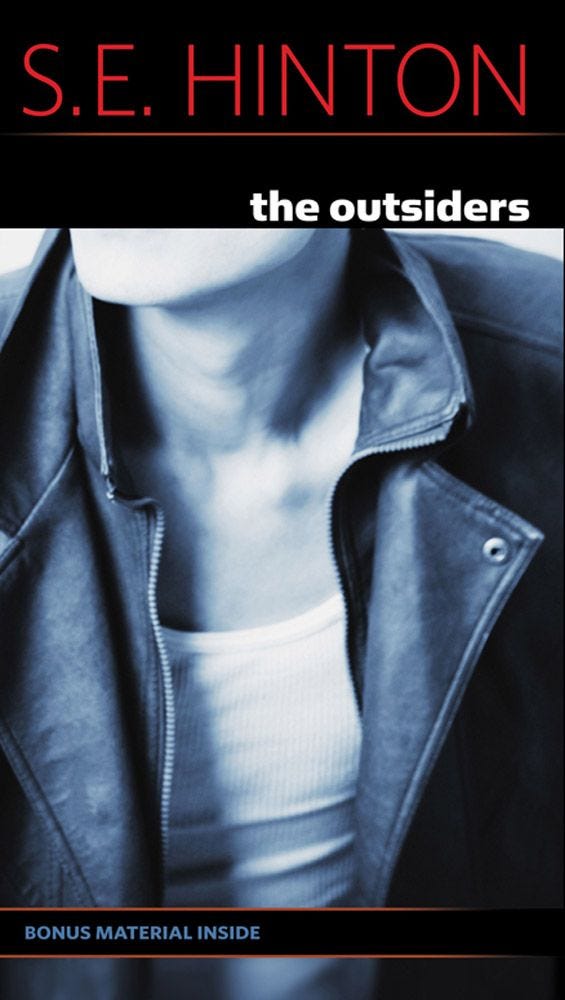
There’s this strange universal truth about growing up in Oklahoma. It can feel like you’re in love with a place that keeps breaking your heart into five million pieces. The never-ending heat (for God’s sake, it was still in the 80s and in mid-October!) and the stillness. The sense that your whole world fits inside a few miles of city surrounded by sudden nothingness, just fields and cows. The Outsiders gets that in a way I’ve never really seen written down before. It’s not just about greasers or Socs. It’s about kids who want more than what the world’s willing to offer them. And even though I’m not a greaser or a Soc, I recognized that ache right away.
The wild part is that S.E. Hinton was sixteen when she wrote it. Sixteen and already writing with that much honesty and self-awareness. The voice feels real, not polished, not trying to prove anything. Ponyboy thinks and feels like an actual kid: sharp, awkward, and aware of beauty, but not sure what to do with it, and not exactly being able to pin down what’s so beautiful about it. His sensitivity doesn’t feel forced; it just is.
What hit me most wasn’t even the plot. It was how Hinton treated these boys. She never flattens them into stereotypes or symbols. They’re violent and tender, loyal and scared. They make awful decisions and still love each other just as hard despite it. The way she writes brotherhood, especially, feels quietly radical. It’s rare to see boys written with that much vulnerability, especially in a book from the sixties.
And somewhere in the middle of reading, I started seeing my dad in them. The violence, the confusion, the loyalty, all the things boys in small towns carry without knowing how to talk about them. My dad grew up in a small town just outside Tulsa. He was a fighter, but he’s also the sweetest guy I know. He wasn’t raised right, not in a way he deserved, and some of that still lingers in the way he loves us from a distance, in the way he guards himself.
He used to talk about how much he loved S.E. Hinton when he was a kid, and I can picture him thirteen years old in the seventies, probably sitting on some cracked porch step, reading The Outsiders and seeing himself in these boys who fight hard because it’s the only language they know. When I read it now, I feel like I can see that version of him. My little kid dad, angry and hopeful and trying to figure it all out on his own.
There’s a weird distance between us even now, something unspoken that’s been built by time and everything that came with it. But reading this book made those spaces between us feel like they were saying something, like I could finally hear the echoes of who he used to be.
In some small way, my sudden S.E. Hinton binge has become a hidden love letter to my father, whether he knows it or not. A way of tracing the line between his youth and mine, through a story that still feels like it belongs to both of us.
And for a story written decades ago, it still moves fast. The writing is tight, clean, and modern. Hinton doesn’t waste words. She says exactly what she needs to say and lets the rest breathe. There’s something timeless in that, a kind of clarity you don’t see often anymore. In a world where most of the books being talked about are over 400 pages, sitting down with a book that’s under 200 was certainly relaxing.
But beyond the writing, what makes The Outsiders work to this day is how much empathy it holds. Every character is seen. No one’s dismissed as just a product of where they’re from. Even the Socs, who could’ve been cardboard villains, get depth. You feel the exhaustion under the violence, the loneliness under the pride. It’s the rare story that doesn’t pick sides, it just asks you to look at people in the fullness of their being.
Reading it now, as someone who’s spent her whole life in Tulsa, it felt like seeing the city in a new light. The empty streets, the too-bright sunsets that you can’t find anywhere (in all my time traveling across the U.S., there’s nothing like a sunset in Oklahoma. Oh, how I get homesick for a sunset at home when I’m away.), the way everything feels familiar but heavy. Hinton caught something true about this place. That weird mix of beauty and claustrophobia it holds. You love it, you hate it, and you never stop feeling it. You’re clawing your way out of here but also feel horror at leaving.
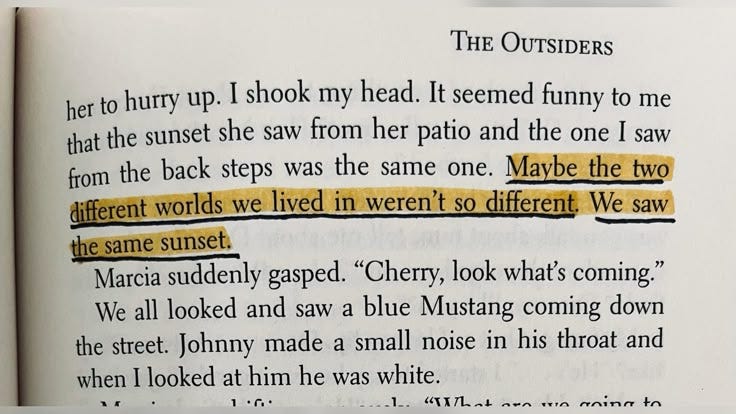
By the time I finished, I got why people still cling to “stay gold, Ponyboy. Stay gold.” It’s not just nostalgia for the story. It’s a reminder to keep something soft alive inside you, even when the world tries to harden it. It’s a reminder to keep that childlike innocence in you and not let this world harden you.
So yes, I was late to this masterpiece of a story. Decades late, even. But maybe that’s okay. I had to grow up here first to really understand it.
Lovely piece. Now I am thinking how extraordinary it is that this book was written in the sixties, yet still conveyed the fragments you love about home the most, all those years later.